
Understanding PDA Profile: Demand Avoidance in Children
Discover what a PDA profile is and how demand avoidance manifests in children. A mum shares insights on why strict boundaries can backfire and offers effective strategies to support children with PDA.
Claire De Oliveira
6/2/20265 min read
This morning I needed three children to brush their teeth. Standard request. Except for one of mine, there's no such thing as a standard request.
So I didn't ask. I called all three names from downstairs and said — out loud, to nobody in particular — "I wonder what order they'll come up in." And I put him last in my guess. Said his name last. Because I knew, absolutely knew, that if I said he'd be last, he'd be first.
And he was. Charging up the stairs. Teeth brushed. Game won.
He didn't brush his teeth because I asked him to. He brushed them because he outmanoeuvred me — because he was in control of the outcome. And that, I think, is the whole thing in one small moment. For a child with a PDA profile, control isn't a behaviour problem. It's a survival need. Once I understood that, kind of everything shifted.
I want to be really upfront, the way I am on the podcast: I'm not a PDA specialist. The profile was only identified for my son this year and I am very much still figuring it out — getting things wrong, adjusting, learning as fast as my ADHD brain will let me. So this is one mum's view from inside it. For proper guidance, the PDA Society are the actual experts, and their resources are free.
What is a PDA profile?
PDA stands for Pathological Demand Avoidance — though more and more people, including a lot of PDA people themselves, prefer Pervasive Drive for Autonomy. I like that framing, because it moves the problem out of the child. "Pathological" puts it inside them. "Drive for autonomy" describes a neurological need.
A PDA profile sits within the autism spectrum. But it can look so different from what people picture as autism that it gets missed all the time — especially in children who are verbal, funny, imaginative and socially switched-on. The defining thing is this: the nervous system experiences demands — even small ones, even gentle ones, even ones the child genuinely wants to do — as a threat to their control. And when control feels threatened, the response is total.
That's not stubbornness. That's a nervous system doing exactly what it was built to do.
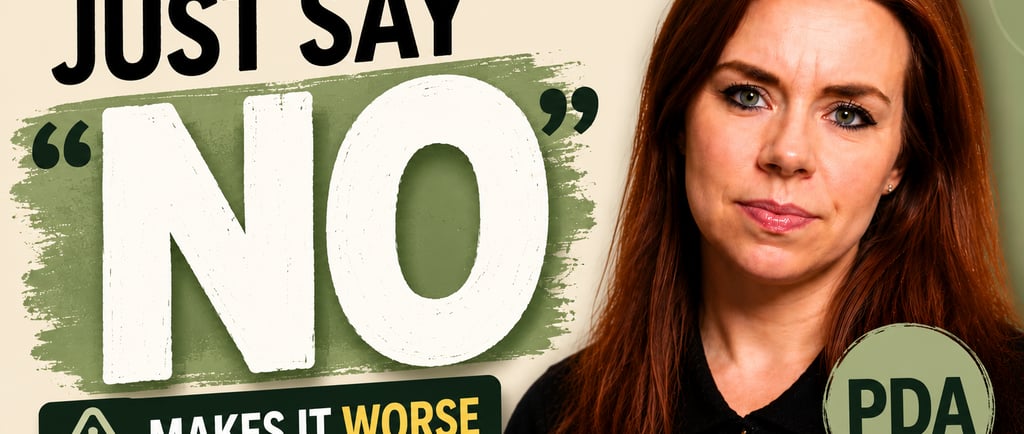
Why "just tell them no" doesn't work
Before anyone said the words "PDA profile," my son was described to me in other ways. Stubborn. Strong-willed. Socially isolated. Disruptive.
None of those people were wrong about what they were seeing. They were just wrong about what it meant. "Stubborn" assumes he's choosing not to comply. "Strong-willed" assumes there's a will you could redirect with the right pressure. And every approach that came with those words — firmer boundaries, consistent consequences, clear expectations — made things worse. Every single time. Not because he was broken. Because those tools were built for a completely different kind of brain.
I know this because I tried them. I'll come back to that.
How is a PDA profile diagnosed?
Here's the honest bit: you can't really go and "get" a PDA diagnosis. There's no PDA test, no PDA clinic. At best, an assessor identifies the profile during an autism assessment and notes it — but that depends on them knowing what PDA looks like and choosing to look. Many don't. So children get labelled with Oppositional Defiant Disorder, or anxiety, or nothing at all.
If you suspect a PDA profile, you can ask your GP for an autism assessment and specifically request that PDA is considered, using the PDA Society's practice guidance as your reference. And if your NHS wait is over 18 weeks, you may be eligible for Right to Choose (though heads up — some areas are pausing this, so check current availability first).
But here's what I really want parents to hear: you don't need a diagnosis to start. The strategies work because they address the underlying need, not the label. That isn't just me saying it — the independent ADHD Taskforce's final report (Nov 2025) explicitly recommends support based on need, without waiting for a formal diagnosis. It's only a recommendation so far, not in force. But the principle is right, and you can act on it at your own kitchen table today.
Low-demand strategies that actually help
A caveat first, because it matters: what works today might be useless tomorrow. That's not failure — that's the profile. The moment a strategy becomes familiar, it stops working. So the goal isn't to find the strategy. It's to get fluent enough in the approach that you can keep generating new ones. Here's what's working for us right now.
The game. That's the teeth-brushing story. Reframe the demand as a competition he can win, and suddenly he's not complying — he's outmanoeuvring me, and he's delighted with himself.
Choices, not instructions. Same task, same outcome — but he chose it. Now or in five minutes? Red pen or blue? The school have been brilliant at this and it changes everything.
Low-demand language. "I wonder if anyone could…" or "No pressure, but…" The request is still there. It's just offered as a possibility, not an expectation — and for a PDA nervous system, the gap between those two things is enormous.
Natural consequences over imposed ones. Imposed consequences feel like control being taken away, which triggers the exact response you were trying to avoid. Natural consequences land as information, not punishment. PDA kids are often deeply logical — they respond to logic in a way they can't respond to authority.
Watch out for internal demands. This one took me ages to understand. Sometimes he can't do a thing he genuinely wants to do — eat the favourite food, start the favourite game — because the wanting itself has become a demand. He's not winding you up. His nervous system has turned "I should" into a threat. The answer isn't pushing. It's lowering the stakes: "It's here if you fancy it, no pressure" — and then actually walking away.
"Aren't you just giving in?"
From the outside, low-demand parenting can look like a parent caving. Constantly. To everything. And I've felt that perception — the looks, the comments about consistency and boundaries. Whether people were really judging me or my RSD was doing the work, I genuinely couldn't always tell you.
So I want to say this clearly: choosing your battles is not giving in. Giving in is abandoning your values because the fight got hard. Choosing your battles is deciding, on purpose, which things actually matter. If he's safe — does it really matter if he eats his dinner standing up? No. The dinner where everyone's regulated and present, even with one person standing, beats the dinner where someone's been pushed past their limit and everyone's miserable.
That's not weakness. It took me a long time to call it what it is, which is wisdom.
And honestly — I got it wrong first. When the behaviour started at nursery I decided I'd been too soft, swung hard the other way into rules and consequences, and made everything about ten times worse. Because I was taking away the one thing his nervous system needed most. I didn't know any better. Nobody had given me the right lens. And now I know differently, and that's enough.
If you've been told your child is stubborn or strong-willed or manipulative — those words might be right about what your child is doing. They're wrong about why. And the why changes the question entirely. Not "how do I make them comply," but "what do they need to feel safe enough to engage."
If this is the kind of week where everyone's nervous system is fried — including yours — I made a free Two-Circle Reset, a five-minute thing for when you've got nothing left in the tank. You can grab it here: the-weighted-blanket.kit.com/5minreset?src=blog
And the full episode goes much deeper — the diagnosis maze, what the research says about PDA kids, the things nobody warns you about. Have a listen wherever you get your podcasts: linktr.ee/theweightedblanket
So I'll ask you what I always ask: what do you wish someone had told you about your child — or yourself — before you had to figure it out the hard way? Come and tell me.
You're not alone. I'll see you in the next one. — Claire